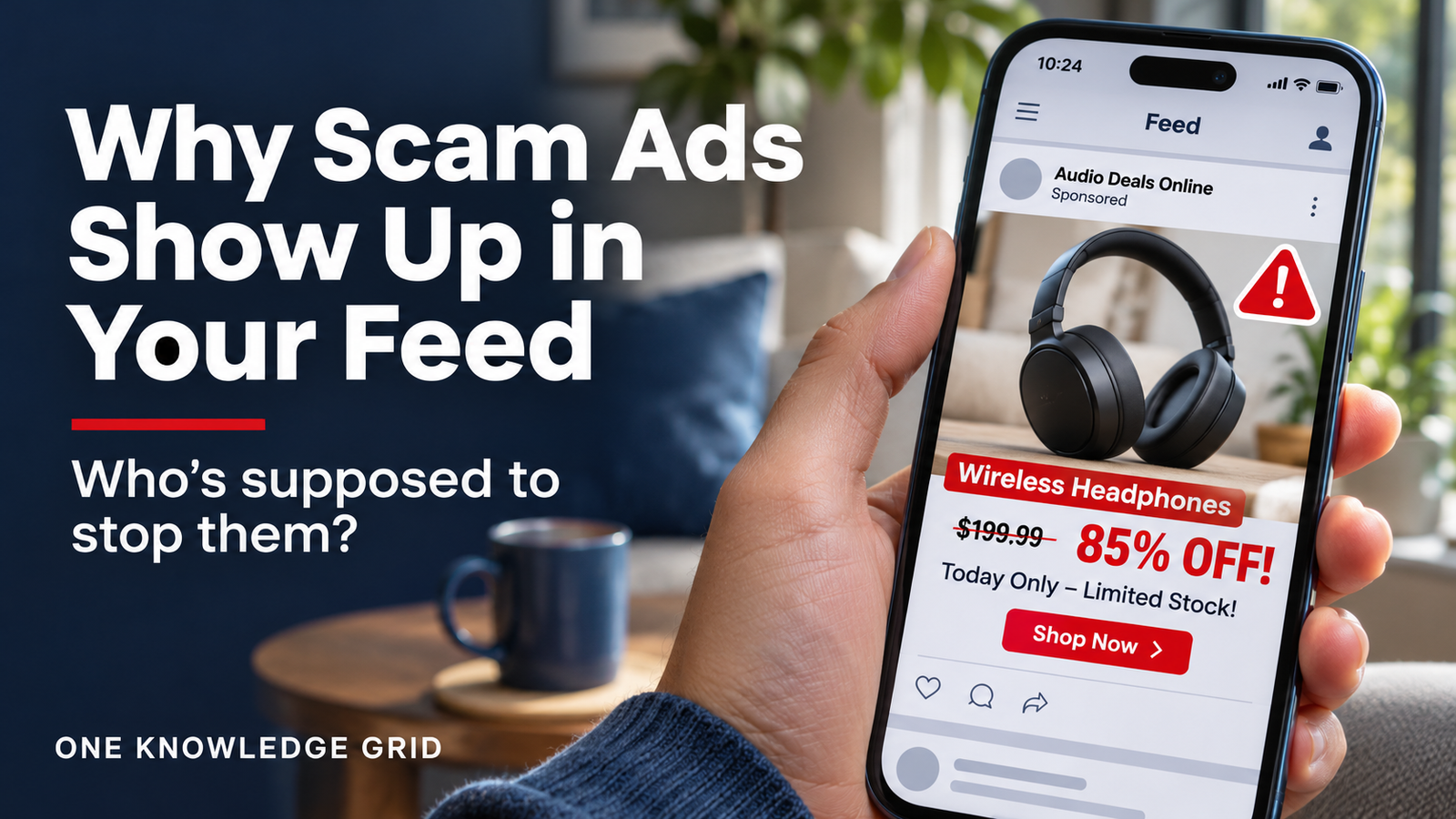
Social media scam ads don’t always look suspicious. Sometimes they look like a clearance sale from a retailer you recognize, a video featuring a familiar celebrity, or a product you were just thinking about buying. Sometimes they look like a clearance sale from a retailer you recognize, a video featuring a familiar celebrity, or a product you were just thinking about buying.
You see the company name, scroll through a few photos, and notice the “Sponsored” label. It’s easy to assume the platform checked the business before accepting its money and showing you the ad.
That assumption gives the advertisement more credibility than it deserves. The Federal Trade Commission warns that social media platforms don’t always thoroughly vet the ads they display or the advertisers behind them. An offer can appear in your feed without the seller having undergone the kind of investigation you might expect.
So how does a fraudulent advertisement end up beside posts from your friends—and who should be responsible for keeping it out?
How Social Media Scam Ads Reach Your Feed
Scammers can buy advertising using the same tools available to legitimate businesses. Those tools can help them reach people based on interests and shopping habits, according to the FTC.
Suppose you’ve been looking for new patio furniture. An advertisement appears offering an outdoor dining set at a fraction of the price you’ve seen elsewhere. Because the product fits what you want, you give it a closer look.
The advertising system has done a good job of finding an interested shopper. Whether the seller deserves your business is another question.
That distinction can be easy to miss when an offer feels personally relevant. For more context on the information economy surrounding personalized advertising, see Your Personal Information Is for Sale. And It’s Completely Legal.
What Does Ad Review Actually Check?
Platforms have advertising standards and systems for reviewing ads. Those reviews serve a purpose, but they shouldn’t be mistaken for a guarantee that a business will deliver what it promises.
Meta’s advertising training materials describe a process that relies primarily on automated tools, with human reviewers involved in some cases. The process helps determine whether an advertisement should be approved or rejected under the company’s standards.
Fraudulent advertisers also work around those checks. Meta describes a technique called “cloaking,” in which a website shows one version of its content to an advertising review system and something different to actual visitors. The page used to pass screening can conceal what shoppers eventually encounter.
An approved advertisement therefore leaves important questions unanswered. Who operates the business? Is it authorized to use the brand name? Will the product arrive? What happens if the customer needs a refund?
Seeing the ad in a familiar app doesn’t settle any of those questions.
A Familiar Logo Can Hide an Unfamiliar Seller
A recognizable brand gives a scammer a shortcut to your trust.
The FTC warns that scammers impersonate established companies and advertise deep discounts on brand-name products. Their ads can lead to fake websites where shoppers receive counterfeit merchandise, get nothing, or expose information that could be used for identity theft.
Imagine an advertisement claiming a major retailer is closing a warehouse and selling its remaining inventory. The logo looks right. The product photographs look professional. The offer includes a deadline that makes you reluctant to wait.
Before considering the price, establish whether the retailer is actually involved. A brand name displayed in an advertisement doesn’t prove the brand placed it.
Even when a seller is legitimate, a dramatic discount deserves scrutiny. As we explain in How Black Friday Pricing Really Works, the size of an advertised markdown tells you little without a meaningful price comparison. An unfamiliar seller adds another reason to slow down.
Who Should Stop Social Media Scam Ads?
The person or business creating the fraud bears responsibility for the deception. But the platform controls access to its advertising system and accepts payment to distribute the advertisement. It has a substantial role in preventing fraudulent campaigns from reaching users.
Shoppers can investigate a website and question an offer. They cannot examine the advertiser’s internal account history, identify connections between advertising accounts, or inspect the warning signals available to the platform.
That is why consumer caution cannot carry the entire burden.
Meta says its enforcement efforts include disabling related accounts, blocking scam domains, and suspending payment methods. In February 2026, the company also announced lawsuits against alleged scam advertisers. These are the company’s descriptions of its response, rather than independent evidence that its protections are sufficient.
Regulators provide another form of accountability. The FTC says its Impersonation Rule prohibits impersonating businesses and government agencies. In November 2026, the agency also said it was considering additional rules or amendments addressing digital platforms that further impersonation scams. Those potential changes were still under consideration.
Consumers have good reason to expect platforms to investigate suspicious advertisers and respond effectively to reports. A warning to shop carefully helps, but it doesn’t resolve failures in the system selling the advertising space.
Check the Offer Somewhere Else
When an ad interests you, step outside it before making a purchase.
Open the retailer’s official app or visit its website using an address you already trust. Look for the promotion there. If you contact customer service, use information from that established source.
The FTC recommends searching the seller’s name with words such as “scam” or “complaint” and comparing prices elsewhere. A price far below what other sellers charge warrants investigation.
You don’t need to prove an advertisement is fraudulent before deciding to wait. Unanswered questions about the seller, the payment process, or the offer itself are enough reason to pause.
If You Already Paid
Contact your bank, card issuer, or payment provider promptly. Explain what happened and ask whether the transaction can be reversed or refunded. Recovery isn’t guaranteed, but the FTC recommends contacting the company used to send the money.
Save screenshots of the advertisement, the website address, receipts, and any messages. Report the ad through the platform’s reporting tools and submit a report at ReportFraud.ftc.gov.
If you shared a password, change it on that account and anywhere else you reused it. Enable two-factor authentication as well. The FTC’s guide for people who were scammed explains recovery steps for different payment methods and types of information exposure.
Social media scam ads benefit from appearing somewhere people already feel comfortable. Before buying, check who is behind the offer through a source outside the advertisement. The seller should earn your trust separately from the app displaying it.