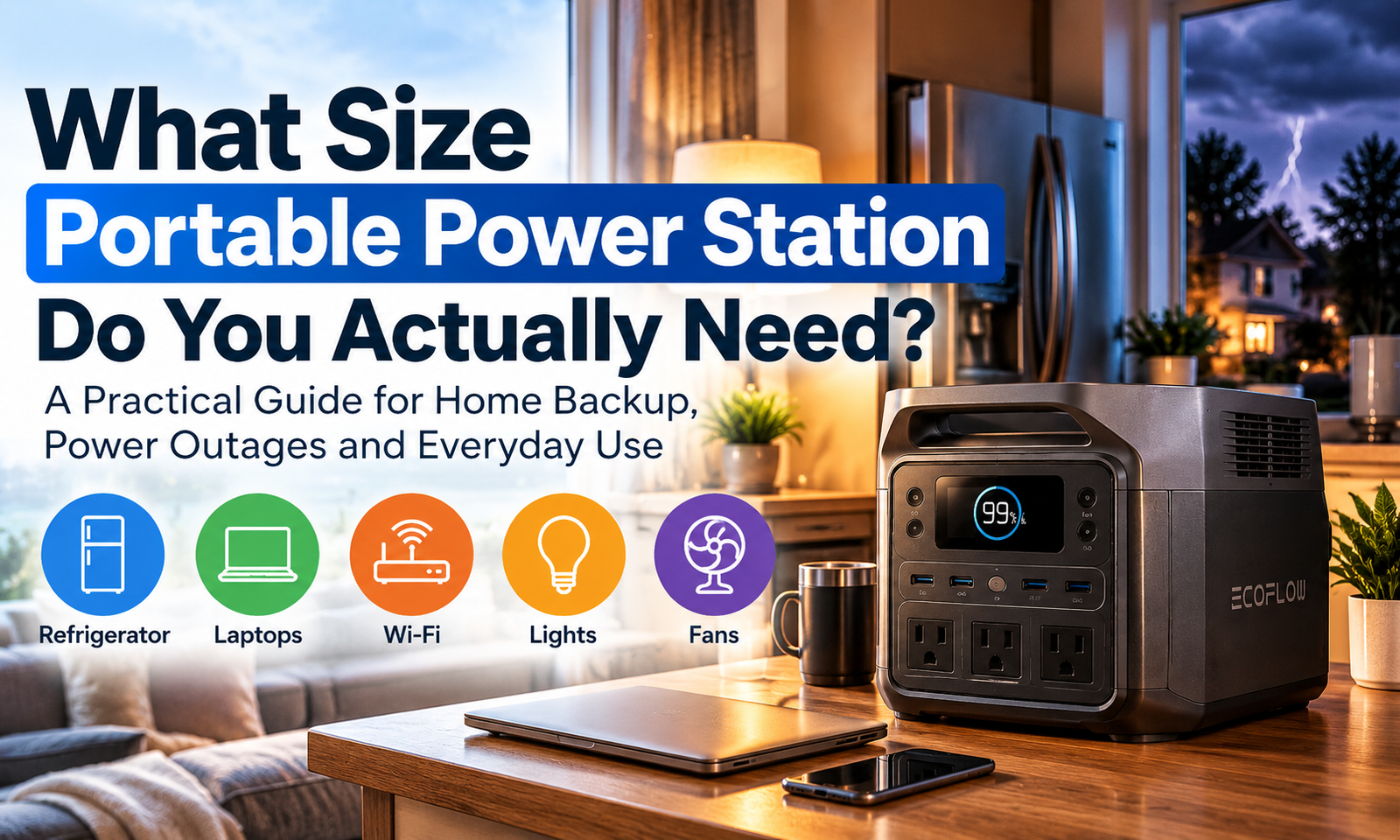
What Size Portable Power Station Do I Need? A Practical Buying Guide
From charging phones and laptops to keeping a refrigerator running during an outage, learn how to choose the right portable power station for your household.
What size portable power station do I need? It’s an increasingly common question among consumers looking for reliable backup power during outages, emergency preparedness, camping trips, and everyday activities away from electrical outlets.
A portable power station can provide electricity when traditional power sources are unavailable. Depending on its capacity and output, it may keep your smartphone charged, support a home office, operate a Wi-Fi router, power lighting, or run certain household appliances. Larger systems can provide additional backup capabilities, although they cannot necessarily replace a dedicated whole-home backup system.
The challenge is knowing how much battery capacity you actually need. Shopping for a portable power station introduces specifications such as watt-hours, AC output, surge capacity, lithium iron phosphate batteries, solar charging, and expandable storage. These features can be difficult to compare, particularly when manufacturers emphasize different performance measures.
It’s tempting to assume that buying the largest battery within your budget is the safest decision. However, a larger power station often means a higher purchase price, additional weight, and equipment that may provide more capacity than your household will realistically use.
The better approach is to identify which devices you need to operate, determine how much electricity they consume, and estimate how long you’ll need backup power. Understanding those requirements can help you choose a system that balances capacity, portability, performance, and cost.
Affiliate disclosure: This article contains affiliate links. As an Amazon Associate I earn from qualifying purchases.
Understanding Watts and Watt-Hours Before You Buy
Two of the most important specifications when comparing portable power stations are watts (W) and watt-hours (Wh). Although the terms look similar, they measure different things, and understanding the distinction is essential to choosing the correct equipment.
Watts measure power consumption or output at a particular moment. Every electrical device requires a certain amount of power while operating. A Wi-Fi router may consume relatively little electricity, while a microwave, hair dryer, or portable heater can require substantially more. The power station’s rated output determines how much electricity it can deliver to connected equipment simultaneously.
Watt-hours measure stored energy. A portable power station rated at 1,000Wh stores approximately twice the energy of a 500Wh system. In general, greater battery capacity allows compatible devices to operate for longer periods, assuming comparable loads and operating conditions.
However, battery capacity doesn’t tell the entire story. Some electricity is lost during power conversion, and the station itself may consume energy while operating. Consequently, a 1,000Wh battery won’t necessarily deliver 1,000Wh of usable electricity through its AC outlets.
Consider a simple example. Suppose you’re preparing for an outage and want to operate a 10-watt internet router for eight hours, a 60-watt laptop for four hours, and 20 watts of lighting for five hours. Your estimated energy requirements would be 80Wh for the router, 240Wh for the laptop, and 100Wh for the lighting, totaling 420Wh.
The basic calculation is:
Device wattage × hours of operation = watt-hours required
If you assume, for planning purposes, that approximately 80% of the battery’s rated capacity will be usable, the 420Wh requirement becomes approximately 525Wh. A power station in the 600–750Wh range could therefore be worth considering for this example, allowing some additional flexibility. Actual results will depend on device consumption, conversion efficiency, and the power station’s operating characteristics.
It’s also important to verify the equipment’s continuous output rating. If multiple devices operate at once, their combined power demand must remain within the power station’s limits. Appliances with motors or compressors may also require a short burst of additional startup power.
This distinction between stored energy and power output is why two similarly sized power stations may be capable of operating different equipment.
What Size Portable Power Station Is Right for Your Household?
Portable power stations are available in several capacity ranges, from compact models intended primarily for electronics to much larger systems capable of supporting multiple appliances. Each category serves different needs, and the appropriate choice depends on the equipment you intend to operate.
| Battery capacity | Typical applications | Best suited for |
|---|---|---|
| 250–500Wh | Phones, laptops, routers, lights, small fans | Travel, basic backup, short outages |
| 500–1,000Wh | Multiple electronics, TVs, fans, selected small appliances | Home offices, camping, moderate backup |
| 1,000–2,000Wh | Refrigeration and multiple household essentials, subject to power limits | More substantial emergency backup |
| Above 2,000Wh | Higher-demand appliances, longer runtimes, larger backup configurations | Extended outages, RVs, off-grid applications |
These ranges are general starting points rather than guaranteed appliance compatibility or runtime estimates.
Smaller Power Stations: 250–500Wh
A portable power station between 250Wh and 500Wh may be sufficient if your primary concern is keeping essential electronics working during a temporary power interruption.
For example, someone living in an apartment might want enough electricity to charge a smartphone, run a laptop, maintain basic lighting, and keep internet equipment operating for several hours. A smaller unit may address those needs without requiring the cost or storage space associated with a large battery.
Compact power stations are also useful for camping, road trips, photography, and remote work. Their relatively modest size and weight can make them easier to transport, particularly when the equipment will be moved frequently.
The trade-off is limited stored energy and, on some models, lower power output. A smaller station may be excellent for electronics but unsuitable for high-demand appliances.
Mid-Size Power Stations: 500–1,000Wh
Moving into the 500–1,000Wh category provides additional flexibility for households that need more than occasional phone charging. Depending on the model, these systems may support laptops, networking equipment, televisions, fans, lighting, and certain smaller appliances.
This range can be particularly appealing for people who work from home or want backup power for several everyday necessities. Instead of choosing between charging a laptop and maintaining internet connectivity, a suitably sized system may support both activities for a useful period.
However, capacity must still be matched to expected runtime. A 700Wh power station may keep low-wattage electronics operating for many hours, while a more demanding appliance could consume much of that available energy relatively quickly.
Larger Power Stations: 1,000–2,000Wh
For consumers interested in powering more substantial household essentials, the 1,000–2,000Wh category is often worth investigating.
Systems in this range may be capable of operating a refrigerator, keeping internet equipment online, charging personal electronics, and supporting selected lighting or work devices. The amount of time each item can operate depends on its actual electricity consumption and whether other equipment is using the battery simultaneously.
A refrigerator is an especially important example because its compressor cycles on and off rather than drawing the same amount of electricity continuously. Some models also require substantial startup power. A power station must have enough output to handle the compressor’s startup demand, as well as sufficient stored energy to operate it for the desired period.
A 1,000Wh battery should not be assumed to operate every refrigerator for a predetermined number of hours. Measuring or verifying the appliance’s power consumption is the most dependable way to estimate its requirements.
For households anticipating frequent outages, choosing enough capacity for the most important devices can provide greater value than trying to power everything in the home at once.
High-Capacity Systems: Above 2,000Wh
Portable power stations with capacities above 2,000Wh are designed for consumers with more substantial energy requirements. Depending on their output ratings, they may support several household appliances, additional refrigeration, work equipment, or extended camping and recreational-vehicle use.
Some larger systems allow additional batteries to be connected, providing the option to expand storage capacity over time. This can be useful for households that expect their backup-power requirements to increase or prefer purchasing a smaller system initially.
However, not every portable power station is expandable. Buyers should confirm compatibility before purchasing, particularly if they anticipate needing additional storage later.
Higher-capacity systems are also generally heavier, more expensive, and more demanding to transport or store. Even a large portable unit may fall far short of the capacity needed to operate central air conditioning, electric heating, or an entire house for an extended outage.
What Can a Portable Power Station Actually Run?
Battery capacity matters, but understanding the demands of individual appliances is equally important. Some devices use comparatively little electricity, while others consume substantial power in a short period.
A refrigerator is one of the most common appliances consumers want to protect during an outage. Many portable power stations can operate certain refrigerators, but the equipment must support both the appliance’s normal running requirements and its startup surge. The refrigerator’s age, size, efficiency, surrounding temperature, and how often the door is opened can all influence energy consumption.
If refrigeration is a priority, it is worth taking the time to measure the appliance’s usage or review its manufacturer specifications. A refrigerator thermometer is also useful for monitoring food safety. According to FoodSafety.gov, a refrigerator generally keeps food cold for approximately four hours during an outage when the door remains closed. A full freezer may maintain a safe temperature for approximately 48 hours, or 24 hours when half full, assuming the door stays closed. Those estimates apply to an unpowered appliance and do not establish how long a battery will run it.
Microwaves present a different challenge. Although they may operate for only a few minutes, their power demand can be substantial. A microwave’s advertised cooking wattage may also differ from the electricity it draws from an outlet. Before connecting one to a power station, compare the appliance’s input requirements with the station’s continuous AC output and applicable surge capabilities.
Electric heaters, kettles, hair dryers, and similar appliances can place even greater demands on portable batteries. Many portable space heaters draw approximately 1,500 watts at their highest setting. Even if a power station can supply that amount, the heater can exhaust a moderately sized battery very quickly. Using stored electricity to produce heat may therefore be impractical for extended emergencies.
Medical equipment requires additional care. Portable power stations are sometimes considered for CPAP machines and other electrically powered devices, but their suitability depends on the exact machine, power requirements, accessories, and compatibility. Heated humidifiers and tubing can significantly change CPAP energy consumption. Anyone relying on electricity-dependent medical equipment should verify the manufacturer’s requirements and establish a dependable emergency backup plan with the appropriate healthcare provider. A consumer power station should not be assumed to provide uninterrupted medical-grade backup simply because it has sufficient rated capacity.
Home internet equipment deserves consideration as well. Your modem, router, and mesh Wi-Fi units all require electricity, even when the internet provider’s external network remains operational. A power station or appropriately sized uninterruptible power supply (UPS) can help maintain local networking equipment during shorter outages, although connectivity will still depend on whether the provider’s infrastructure remains available.
The practical lesson is to prioritize equipment. Keeping a refrigerator, internet connection, a few lights, and essential communications functioning may provide more benefit than attempting to operate every appliance in the house.
A 1,000Wh-Class Product Worth Comparing: EcoFlow DELTA 3 Classic
For readers considering a portable power station around the 1,000Wh range, the EcoFlow DELTA 3 Classic provides a useful example of the specifications available in this category.
According to EcoFlow, the DELTA 3 Classic offers 1,024Wh of battery capacity and 1,800W of continuous AC output, with a manufacturer-advertised surge rating of 3,600W. It uses lithium iron phosphate (LiFePO4) battery chemistry and supports several charging methods, including household AC power and compatible solar panels.
These specifications illustrate why battery capacity and output power need to be evaluated together. Its 1,024Wh capacity determines the approximate amount of stored electricity, while the 1,800W AC rating determines the continuous load it can support through its AC outlets.
The unit may be worth considering for households interested in backup power for electronics, networking equipment, selected appliances, or short-term emergency use. Its solar input capability may also appeal to consumers who want the option to recharge when ordinary electrical outlets are unavailable.
The DELTA 3 Classic weighs approximately 12.1 kilograms, or about 27 pounds, making portability another consideration. It is movable, but it is considerably heavier than a small power bank or compact power station.
Importantly, the DELTA 3 Classic does not support expansion with additional batteries. Consumers who anticipate needing significantly more capacity later should compare other models that explicitly offer expansion capability.
Whether this particular unit is appropriate depends on the appliances being powered, expected runtime, charging needs, and overall budget. Buyers should also compare warranty terms and understand the product’s operating limitations before purchasing.
Compare the EcoFlow DELTA 3 Classic Portable Power Station on Amazon
Product information is based on manufacturer specifications. One Knowledge Grid has not independently tested the DELTA 3 Classic. Product availability, prices, and specifications may change.
Battery Chemistry, Solar Charging, and Long-Term Ownership
Portable power stations are not simply batteries with electrical outlets. Their battery chemistry, charging technology, safety features, and software controls can influence how practical they are to own over time.
Many modern systems use lithium iron phosphate, commonly called LiFePO4 or LFP. This battery chemistry is valued for its thermal stability and generally long cycle life. However, battery longevity varies by manufacturer, temperature, charging practices, and usage patterns. Claims that a particular battery will last ten years or several thousand cycles should be understood in the context of the manufacturer’s testing assumptions and warranty.
Consumers should evaluate the quality of the battery-management system, product certifications, warranty coverage, and manufacturer support rather than treating battery chemistry as the only indicator of quality. Lithium-ion batteries can still present fire hazards when damaged, improperly charged, or exposed to extreme conditions.
Charging options also deserve attention. Most portable power stations can be recharged from ordinary household electrical outlets, while some support vehicle charging or compatible solar panels. Recharge times depend on battery capacity, charging power, temperature, and the system’s input limitations.
Solar charging can be particularly appealing for camping, off-grid activities, or outages lasting longer than the battery’s initial stored energy. However, solar panels do not provide a guaranteed daily recharge. Their output depends on available sunlight, weather, panel placement, rated capacity, and the power station’s solar-input limit. A panel advertised at 200 watts will not necessarily deliver that output throughout the day.
Consumers should also compare whether solar panels are included or sold separately. Purchasing a bundle may be convenient, but it isn’t always necessary for someone whose primary use will be occasional backup power at home.
Storage and maintenance matter just as much as charging. Follow the manufacturer’s instructions concerning operating temperatures, ventilation, storage charge levels, and periodic maintenance. Equipment should be kept away from excessive heat, moisture, and materials that could create a fire hazard. Products showing swelling, leaking, unusual odors, or excessive heat should not continue to be used or charged.
For households purchasing emergency equipment, the most valuable system is one that remains usable when an outage actually occurs. Checking the charge level periodically, testing intended devices safely, and maintaining compatible charging accessories can help make the purchase more dependable.
Portable Power Station, Power Bank, or Gas Generator?
Not everyone needs a large portable power station. In fact, one of the smartest purchasing decisions may be choosing a smaller product that adequately meets your needs.
If your primary concern is charging smartphones, tablets, headphones, or similar USB-powered electronics, a high-capacity power bank may offer a more affordable and portable solution. Many power banks also support laptop charging when equipped with suitable USB-C Power Delivery capabilities. For consumers who don’t need AC outlets or appliance support, a full power station may be unnecessary.
Portable power stations become more useful when you need substantially greater stored energy, conventional AC outlets, or the ability to operate certain household equipment. They are especially appealing for quiet, relatively simple backup power without the exhaust produced by gasoline engines.
Gas-powered generators serve a different purpose. Depending on the model and available fuel, they may provide higher sustained power output and longer operation than a standalone battery. However, generators require fuel, maintenance, and careful placement. Their exhaust contains carbon monoxide, which can cause fatal poisoning.
The U.S. Consumer Product Safety Commission advises operating portable fuel-powered generators outdoors only, at least 20 feet away from a home, with exhaust directed away from windows, doors, and other openings. A gasoline generator must never be operated inside a house, garage, shed, or similarly enclosed area, even with doors or windows open.
Portable battery power stations avoid engine exhaust during normal operation and can be used indoors when the manufacturer permits it and its safety instructions are followed. They still require proper battery handling and electrical safety precautions. Never attempt to power household circuits by plugging a portable power station into a wall outlet. Supplying household wiring requires an appropriate, professionally installed connection system.
Ultimately, the choice depends on whether you need limited electronics charging, moderate household backup, or sustained power for more demanding equipment.
What to Consider Before Purchasing
Before buying a portable power station, take an inventory of the equipment you would want to operate during a power interruption. Begin with essentials rather than assuming every device needs to remain powered. A household may prioritize refrigeration, lighting, communications, and a laptop, while another may focus primarily on outdoor activities or recreational travel.
Next, determine the wattage of each device and how long it will need to operate. Appliance labels, user manuals, manufacturer specifications, and appropriate electricity-usage meters can help establish realistic estimates. Remember to account for devices that operate simultaneously and appliances that need additional startup power.
Think carefully about how the system will be recharged. Someone preparing for occasional short outages may be satisfied with household outlet charging. Consumers planning for longer emergencies, camping, or remote activities may place greater value on compatible solar panels or vehicle charging options.
Portability should also be part of the decision. A larger battery may provide more runtime, but it can be difficult to move, particularly for someone who intends to carry it frequently. Consider the product’s weight, dimensions, handle design, and available storage space.
Finally, review the manufacturer’s warranty, battery chemistry, product certification information, charging limitations, and expansion options. If you anticipate needing additional battery capacity in the future, confirm that the specific model supports expansion rather than assuming all products within the same brand or series have identical capabilities.
Other emergency preparedness products may complement the power station, including rechargeable lanterns, high-capacity power banks, emergency radios, appropriately rated cables, and UPS equipment for computers or networking devices. Choosing a combination of smaller, purpose-built products can sometimes provide greater flexibility than relying entirely on one large battery.
Frequently Asked Questions
How many watt-hours do I need for emergency home backup?
The amount depends on which appliances you want to operate and for how long. A few hundred watt-hours may be sufficient for electronics and lighting during a short outage, while refrigeration and multiple household essentials may justify considering systems around 1,000Wh or higher. Extended backup for substantial household loads often requires considerably more storage capacity.
Can a portable power station run an entire house?
Most standalone portable power stations are not intended to operate an entire home. Whole-home backup usually requires a larger, properly installed battery system, an appropriately configured generator, or another dedicated backup solution. High-demand equipment such as central air conditioning, electric heating, and cooking appliances can require substantial output and storage capacity.
Can I charge a portable power station while using it?
Some portable power stations support pass-through charging, allowing compatible devices to receive power while the station itself is charging. However, features and operating limitations vary by model. Consumers should check the manufacturer’s instructions before relying on this capability, particularly for critical equipment.
How long does a portable power station battery last?
Battery lifespan depends on chemistry, manufacturer, usage patterns, and storage conditions. Many modern LiFePO4 models are designed for thousands of charge cycles, but their capacity gradually declines over time. A manufacturer’s cycle-life rating and warranty provide more useful guidance than assuming all batteries will last the same number of years.
Do I need solar panels with a portable power station?
Not necessarily. Most consumers can recharge their power stations using standard electrical outlets. Solar panels are an additional option that may be particularly useful during extended outages or activities away from the electrical grid, provided sufficient sunlight and compatible charging equipment are available.
Final Thoughts: Buy the Battery Capacity You Actually Need
Understanding what size portable power station do I need begins with a practical assessment of the devices you want to operate, the electricity they consume, and the length of time you expect to need backup power.
Smaller systems may be sufficient for charging phones, laptops, and maintaining basic connectivity during short outages. Mid-size power stations offer additional flexibility for home offices, travel, and everyday electronics. For consumers who want to operate refrigerators and other essential appliances, equipment in the 1,000Wh category or higher may deserve consideration, provided the power output is also appropriate.
Larger and expandable systems can offer additional capacity, but they also introduce higher costs, greater weight, and more complicated purchasing decisions. More stored energy is useful only when it addresses a genuine need.
Products such as the EcoFlow DELTA 3 Classic offer an example of the capabilities available in the 1,000Wh class, but no single model is ideal for every household.
Before making a purchase, calculate your expected energy requirements, verify the power needs of essential appliances, and consider how the equipment will be stored, charged, and maintained.
The right portable power station isn’t necessarily the biggest battery you can afford. It’s the one that provides dependable power for the devices and situations that matter most to you.
Sources and Further Reading
- U.S. Consumer Product Safety Commission — Generator Safety
- FoodSafety.gov — Food Safety During a Power Outage
- U.S. Fire Administration — Battery Fire Safety
- EcoFlow — DELTA 3 Classic Specifications