
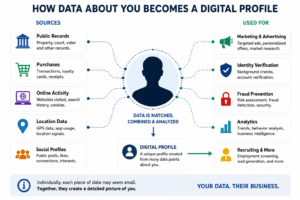
You probably know companies collect information about you.
But here’s what you may not know:
There are companies whose actual business is collecting information about people, building profiles, and selling that information.
They’re called data brokers.
And they’re not hackers operating somewhere in the dark. They’re businesses.
Think About How Much Information You Leave Behind
Your address.
Property records.
Things you buy.
Public social media.
Apps and websites you use.
Other information connected to your everyday life.
One piece may not say much.
But put enough pieces together and you can build something much more valuable:
A profile of you.
That’s where the data-broker business gets interesting.
WAIT—I DIDN’T KNOW THAT
You don’t necessarily have to sign up with a data broker for it to have information about you. You may not even know the company exists.
That People-Search Website Isn’t the Whole Story
Ever searched your name and found one of those websites showing your age, old addresses or possible relatives?
It’s creepy.
So you find the opt-out button and remove yourself.
Problem solved?
Not exactly.
You removed yourself from that company.
Other companies may have information from completely different sources.
That’s the part that’s easy to misunderstand:
Removing yourself from one site doesn’t remove you from the data economy.
The website you found isn’t necessarily the system.
It’s just the part of the system you happened to see.
And “Delete” Doesn’t Always Mean Gone
This is another distinction worth knowing.
Deleting an app doesn’t necessarily delete your account.
Deleting an account doesn’t necessarily erase every record associated with it.
Removing yourself from a people-search site doesn’t make the original public records disappear.
And opting out of one data broker doesn’t mean you’ve opted out of all of them.
Those aren’t the same thing.
California Is Trying Something Different
Instead of requiring consumers to hunt down registered data brokers one at a time, DROP gives California consumers a centralized way to submit a deletion request to registered brokers, subject to applicable exceptions.
Think about why that’s necessary. How do you ask a company to delete your information when you don’t even know the company has it?
Something that can be collected, connected, analyzed and potentially sold or used commercially.
You may never visit the companies doing it. You may never create an account with them. You may never even know their names. And that’s what makes the data-broker industry worth understanding.