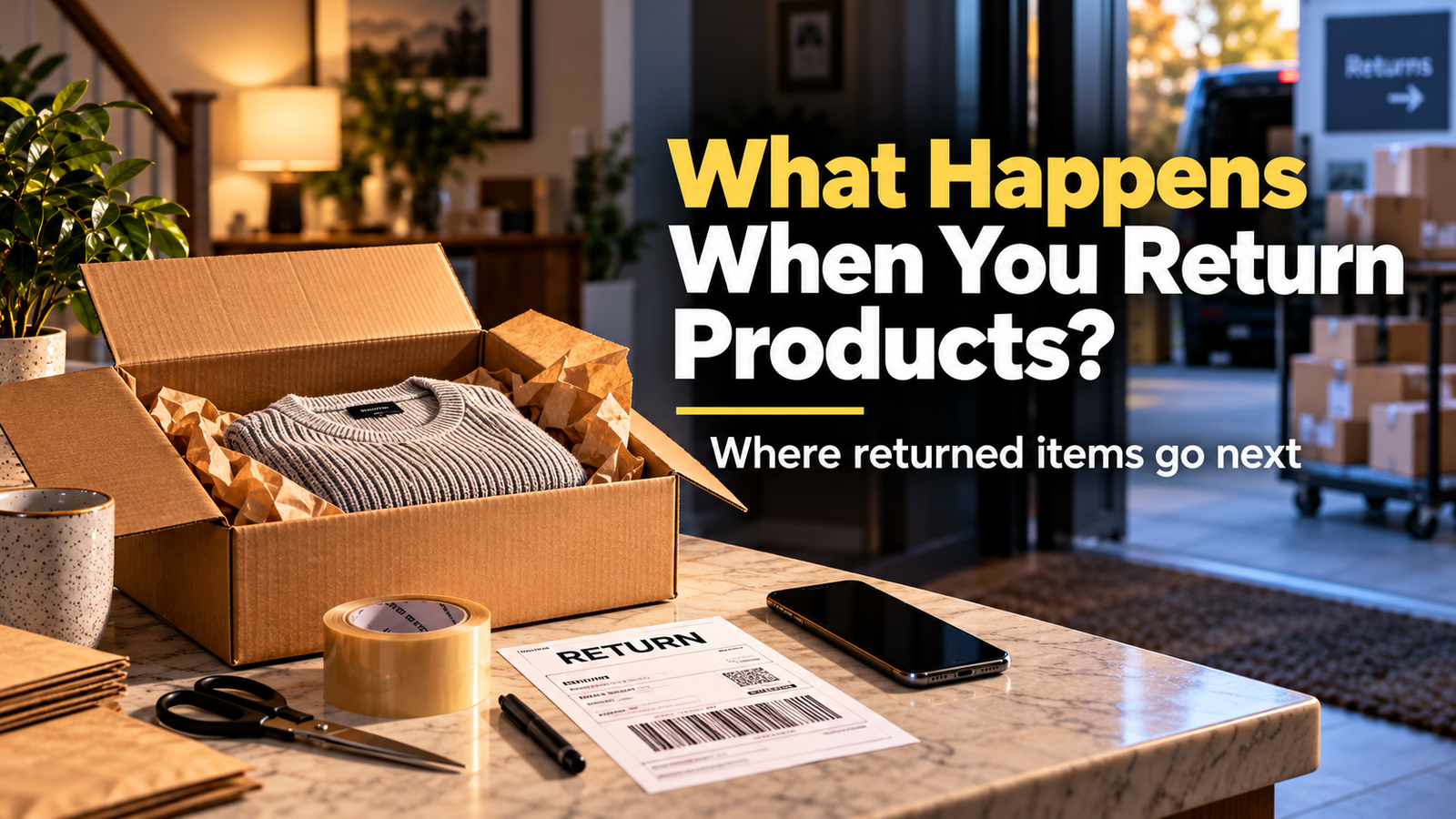
You handed it back. You got your money. But your product’s journey may have just started.
You order a pair of shoes online. They look right, the price is right, and a few days later, they arrive.
Wrong size.
You put them back in the box, start a return, and drop them off. Eventually, a notification arrives: Refund issued.
That is usually where we stop thinking about the purchase.
But what happens to returned products after we walk away? Do those shoes go straight back on sale? Does someone inspect them? Could they end up with an entirely different seller?
The short answer: a return can be restocked, resold at a discount, repaired, donated, recycled, or disposed of. Its destination depends on the product, its condition, the retailer’s processes, and what it takes to recover its remaining value.
And that last part changes how you look at the whole system.
A product can still work perfectly and be expensive to sell again.
Why a return does not simply undo a purchase
From your side, returning something can feel like rewinding a transaction. The product goes back, the money comes back, and the purchase is over.
For the business, another set of decisions begins.
Someone has to establish what came back, what condition it is in, and what can happen next. The system handling that work is called reverse logistics.
The National Retail Federation’s explanation of reverse logistics describes an industry that includes companies moving, processing, repairing, refurbishing, recycling, and reselling returned goods.
Think of the difference this way: selling a new product starts with a reasonably clear idea of what is being offered. A return introduces uncertainty.
Were the shoes worn outside? Is the headphone cable still in the box? Does the appliance actually have a fault, or did the buyer simply change their mind?
Those are different situations, even if the customer-facing result is the same: a refund.
What happens after you drop off a return
A barcode scan makes the handoff look simple. It identifies a transaction and helps connect the physical item to a record.
It does not, by itself, answer every question about the item.
A useful example comes from Amazon’s description of its UK returns centre. The company describes matching incoming products with return records, sorting them, and assessing signs of use, damage, and whether packaging remains sealed.
Its stated routes include regular inventory, discounted resale, donation, secondary markets, and recycling or energy recovery. That is one operation in one country, rather than a rule for every retailer.
The broader point is straightforward: accepting a return and deciding its destination are different jobs.
The box can change the next sale
Imagine two identical pairs of headphones.
One comes back sealed. The other works, but its packaging has been torn open and the accessories have been unwrapped.
The hardware might be equally useful. The offer to the next customer is different.
A person paying for a new product has expectations about condition, completeness, and presentation. An opened item needs an accurate description and may require a different price or sales channel.
That does not automatically make it defective. It means someone needs to work out what can honestly be sold.
A return reason is only part of the picture
“Did not like it” and “does not work” point toward different questions. But an initial description cannot substitute for every check.
Imagine returning a lamp because it would not turn on. An inspection might identify a damaged component, a missing part, or a setup problem. Those hypothetical findings would lead to different decisions.
This is why the story behind a return matters, even when the customer has already moved on.
Where returned products can go
It is tempting to picture a downward sequence: new, then open-box, then refurbished, then waste.
The real system has branches. A product does not have to pass through each category, and a return does not necessarily lose all its usefulness.
| Possible destination | What it can mean |
|---|---|
| Regular inventory | An eligible item is offered again through normal sales channels. |
| Discounted resale | The product is sold with a description reflecting its condition. |
| Repair or refurbishment | Work is performed to prepare it for further use or sale. |
| A secondary market | Another seller or intermediary takes over its next sale. |
| Donation | Suitable goods go to a charitable organization. |
| Parts or material recovery | Components or materials are recovered where feasible. |
| Disposal | The product enters a waste-handling route. |
NRF’s reverse logistics resources describe inspection, repair, repackaging, resale, salvage, and recycling as parts of this broader system.
The important distinction is between a product’s history and its condition. “Returned” tells you that a transaction changed. It does not tell you exactly what you would find inside the box.
Open-box and refurbished deserve a closer look
Suppose you encounter a discounted item that looks almost identical to the new version. The label may say open-box, used, renewed, or refurbished.
Before focusing on the discount, ask what the seller means by that label.
Opened does not necessarily mean broken
An opened package alone does not establish a defect. Our original shoes were the wrong size; our hypothetical headphones had damaged packaging.
But it also does not prove that everything is present or working. The useful information is in the actual condition description, inspection claims, and included-accessories list.
If a listing only says “great deal,” you still have questions to answer.
Refurbished does not tell the entire history
Refurbishment can involve inspection, cleaning, testing, and repairs where needed. The precise promise depends on the program.
For example, Newegg’s refurbished-item guidance lists several possible origins, including defect returns, non-defect returns, damaged packaging, and demonstration units. Its published standards describe cleaning, inspection, testing, and replacement or repair of components that fail its standards.
That example shows why “refurbished” should not automatically be read as “someone bought a broken product.”
It also should not replace the practical questions: Who performed the work? What condition is promised? What happens if it fails?
Why a working product may not return to the shelf
Here is the part that makes returns more interesting than a trip backward through a warehouse.
Usefulness and profitable resale are different calculations.
Consider a hypothetical kitchen accessory that originally sold for $20. After it is opened and returned, suppose a retailer expects to sell it for $12.
Now suppose inspecting, repackaging, handling, and delivering that individual resale would cost $15.
The item might function perfectly. That particular route would still cost more than it brings in.
These numbers are illustrative, not industry averages or a description of a specific retailer’s costs. They show why the original selling price cannot settle the next decision.
Every extra step needs a reason
A business weighing the options has to consider what additional work achieves.
Would replacing a missing cable make resale worthwhile? Would a specialized repair company be better equipped to handle the product? Would another sales channel reach a buyer at a lower processing cost?
The answer can differ between products.
A high-value device may justify attention that would be difficult to justify for an inexpensive accessory. A heavy item creates a different transportation problem from something that fits in a small package.
The central question becomes: Which available route makes the best use of what is left?
Timing changes the calculation
Imagine a holiday decoration returned after the holiday.
It may be complete and undamaged. But the next customer might not want it until the following season. Holding it would mean storing it and waiting for another selling opportunity.
Compare that with a household item someone needs throughout the year.
These examples illustrate why physical condition alone cannot tell the whole story. Demand, timing, and the work required to reach another buyer belong in the calculation too.
Why someone else may sell your return
You may recognize the retailer that sold you a product without recognizing the company that handles its next sale.
NRF describes secondary markets spanning business buyers, consumers, physical stores, and online channels, with liquidators sometimes acting as intermediaries.
That helps explain how an item can leave a familiar retailer and reappear somewhere else.
For a shopper, the useful question is not simply whether it once belonged to another customer. It is what the present seller knows, promises, and will do if something goes wrong.
A vague description does not become more reassuring because the discount is large.
Before buying, check:
- The item’s stated condition and any known defects.
- Whether the photos show the actual item.
- Which accessories are included.
- Whether its functions have been tested.
- Who provides warranty support, if any.
- Whether it can be returned, and under what conditions.
A bargain is easier to assess when you understand the offer.
Not every return finds another buyer
Some returned products cannot practically or safely be put back into use. Others may have limited recovery options.
Donation is one possible destination for suitable goods, as Amazon’s UK explanation illustrates. But a product’s usefulness does not guarantee that a particular organization can accept, transport, store, or distribute it.
Recycling also requires more than deciding that something “should be recyclable.” There has to be an appropriate recovery process for its materials.
And some returns ultimately enter disposal routes. NRF identifies landfill as a possible worst-case outcome in its discussion of returned merchandise.
That does not mean every return is headed for the trash. It means another sale is one possible ending, rather than an automatic result.
How big is the returns system?
In its 2025 Retail Returns Landscape report, NRF and Happy Returns projected $849.9 billion in U.S. retail merchandise returns for 2025.
The report also estimated that 19.3% of online sales would be returned that year.
Those are dated estimates, not live figures. And the merchandise value is not the same thing as the cost of handling returns, the total financial loss, or the amount discarded.
A returned item may generate another sale. It may also require additional spending before that happens.
The scale explains why the process deserves attention. Behind a simple refund button is an operation making decisions about products that have already been manufactured, packaged, transported, and sold once.
What shoppers can do before returning something
A defective or unsuitable product may need to go back. Understanding the system gives you a few practical ways to make the handoff clearer.
Keep the parts together
While deciding whether to keep a purchase, hold onto its accessories and packaging. Before returning it, compare what is in the box with what arrived.
Follow the seller’s specific instructions, including any directions for defective or damaged products.
Describe the problem accurately
If the product failed, explain what happened. If it works but does not suit your needs, say that.
Accurate information gives the next person a clearer starting point than selecting a convenient reason that does not match the situation.
Remove personal information from connected devices
Before returning a phone, tablet, computer, or other connected device, follow the manufacturer’s instructions for backing up information, signing out, removing account locks where applicable, and resetting it.
Do not assume a refund also takes care of your data.
Check suitability before the next purchase
A few questions before checkout can prevent a repeat of the same disappointment.
For home technology, that means looking beyond a product’s headline features. Our guides to choosing a Wi-Fi router for your home and choosing home security cameras offer starting points for evaluating those purchases.
The goal is to understand what fits your situation before the box arrives.
Common questions about returned products
Do all returned products go back on sale?
No. Possible outcomes include resale, repair, donation, material recovery, and disposal. The route varies with the item and the operation handling it.
Does a return always stay at the store where I dropped it off?
No. The drop-off location can be one point in a larger returns network. Amazon’s UK example describes products moving from collection points to a specialized returns centre.
Are all refurbished products previously defective?
No. Newegg’s published examples include non-defect returns and demonstration units as well as products returned for defects. Read the particular program’s standards rather than assuming every refurbished item has the same history.
Can I tell where my individual return ended up?
A refund confirmation alone does not tell you its final destination. A retailer’s explanation of its general process can describe possible routes without tracing your particular item.
Your refund ends one transaction and starts another decision
Go back to those shoes.
You tried them on. They did not fit. You returned them and got your money back.
For you, that was the end of the story.
For someone else, the next task is to establish what those shoes can become: another regular sale, a discounted offer, a donation, or something else.
The product did not disappear when your refund arrived.
It entered a system built to answer a question you no longer had to think about: What happens to it now?