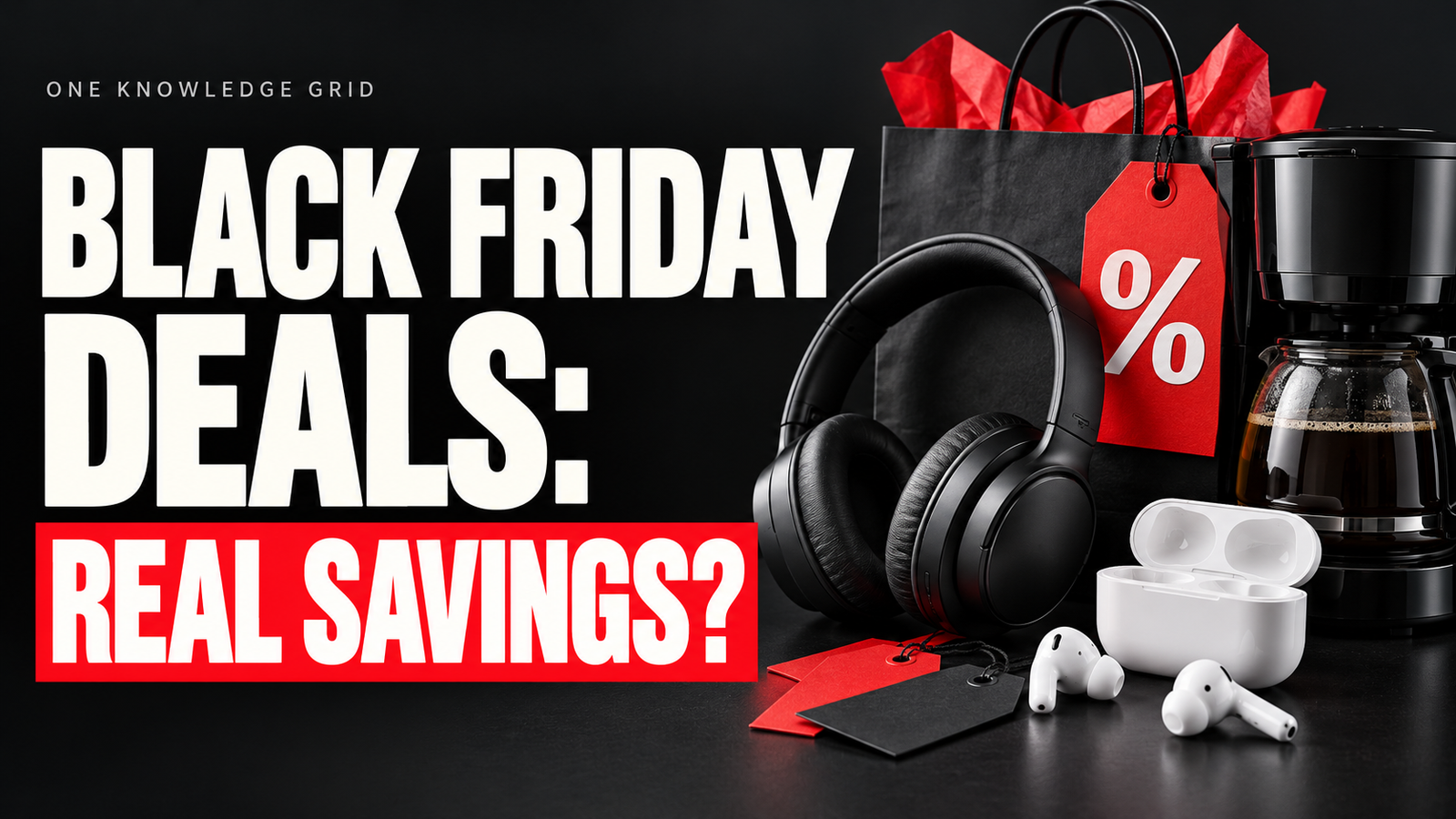
Are Black Friday deals real—or are you looking at an ordinary price dressed up as a bargain?
Some deals offer genuine savings. But a sale label does not tell you whether the price is unusually low, whether another store charges less, or whether the product is worth buying. The useful comparison is the exact item’s price history and total cost, rather than the size of the advertised discount.
A good buying rule: choose the product first, then decide what you are willing to pay.
What the discount actually measures
Every percentage discount needs a starting number. Understanding that number helps you judge the offer.
- Former or “was” price: the seller’s claimed earlier price.
- MSRP or list price: a manufacturer’s suggested retail price. It is not proof that the store previously charged that amount.
- Checkout price: what you actually pay after applicable discounts, shipping, taxes and fees.
The FTC’s Guides Against Deceptive Pricing distinguish genuine former prices from artificially inflated ones used to manufacture an impressive discount. They also warn that suggested prices can mislead when they do not reflect substantial actual sales.
For shoppers, that means “40% off” is the beginning of the investigation. Ask: 40% off which price?
How an ordinary price becomes a headline deal
Consider this hypothetical example in U.S. dollars. These figures illustrate the math; they are not a current offer or a claim about a particular retailer.
A coffee maker is advertised at $120, reduced from $200. That is an advertised saving of $80, or 40%. But suppose your saved price history shows that the same model was available for $130 several times recently.
Compared with that recent $130 price, you would save $10—about 7.7%. The checkout price can still be worthwhile, but the large percentage on the banner tells you much less than the product’s actual price history.
For the underlying principle, the FTC’s pricing guides explain why a genuine former price matters. An inflated reference price can make an ordinary price look like a special bargain. The hypothetical example above illustrates the comparison process; it does not establish that any seller broke the law.
The lesson is to check the history before treating the sale date as a reason to buy.
Try the price check on a real product
The Ninja Specialty Coffee Maker CM401 on Amazon (paid link) gives you a specific model to investigate. Match the CM401 model number when checking other retailers and any available price history. The dollar amounts in the hypothetical example above do not describe this Ninja listing.
Compare what you actually get
Use these questions to weigh an offer against your needs.
| Offer | What to compare | When it may be worthwhile |
|---|---|---|
| A lower price on the exact item | Recent prices and other sellers’ checkout totals | It meets your target price and you need it soon |
| A large discount against MSRP | The model’s actual selling prices | The current price is competitive without relying on MSRP |
| A bundle or gift card offer | The separate cost of items you would buy anyway | You can use the extras without additional spending |
| A membership or coupon price | Eligibility, membership cost and final total | The extra cost does not erase the saving |
| An older or different model | Exact model number, features, condition and warranty | It does what you need at a price that reflects the differences |
A $50 gift card is not the same as $50 off today’s bill. For your own budget, count it only to the extent that it replaces spending you already planned.
Likewise, a cheaper television is not automatically the better purchase if it lacks the connections or features you need. Decide which specifications matter before comparing prices.
Three listing details that change the comparison
Condition: This Sony WH-1000XM5 listing on Amazon (paid link) is labeled Renewed. Check its condition description, seller, guarantee and return terms before comparing it with a new pair. A difference in condition needs to be part of your buying decision.
Bundle contents: This Sony WH-1000XM6 bundle on Amazon (paid link) includes a microfiber cleaning cloth in the listing title. Compare the same headphones sold separately, and decide what the extra is worth to you. The XM5 listing above and this XM6 bundle differ in generation and listing format; they are not an identical-product price comparison.
Generation and version: The linked listing identifies these as Apple AirPods 5 with Active Noise Cancellation and Wireless Charging Case on Amazon (paid link). Confirm that the selected option, model information and item in your cart all match. A listing for a different generation or version should be evaluated as a different product.
These links illustrate how to inspect an offer. They are not claims that these products currently have the lowest price or a verified Black Friday discount.
A checklist before you buy
The FTC’s online shopping guidance recommends comparing model details and total costs, checking return terms, and retaining purchase records. Put that into practice:
- Confirm the exact product. Match the full model number, size, condition and included accessories.
-
Check its history. Look for prices before the promotion; if a tracker has no history for that model, treat the claimed saving as unverified.
-
Compare sellers. Check the same item at more than one established retailer.
-
Calculate the final cost. Include shipping, taxes, required memberships and any extras you choose.
-
Read the return terms. Check the deadline, return shipping and restocking fees, especially for sale items.
-
Check any price promise. Confirm whether this item and promotion qualify, and how to request an adjustment.
-
Save the evidence. Keep the offer, receipt and applicable policies.
If the product has no useful price history, you can still assess its specifications and competing products. You simply cannot confirm that it is a historical low.
Three common questions
Does a real discount mean the best deal of the year?
No. A genuine reduction can match an earlier promotion. A sale claim by itself does not establish a year’s lowest price. Check the history for the exact product.
Are “was” prices and manufacturer prices interchangeable?
No. They describe different comparisons. Read the label beside the crossed-out number instead of assuming it means the store’s most recent price.
Should I always wait for Cyber Monday?
There is no universal answer for an individual product. Without verified future prices, nobody can promise waiting will save you money. If the exact item meets your target price and you need it, buying can be reasonable. If the offer is poorly documented or over budget, pause.
For US readers, the FTC’s pricing guides provide a federal reference point. State requirements can also matter; the FTC’s advertising guidance directs businesses to state attorneys general for local pricing issues. Do not assume a pricing rule from another country applies to your purchase.
One thing to do today
Choose one item you already intend to buy. Record its exact model number, today’s price at two retailers and your maximum acceptable checkout total. Save those details before the next promotion arrives.
You will then have your own comparison point when a sale banner asks you to act quickly.
Suggested follow-up guide: How to compare product models before you buy—covering specifications, warranties, accessories and ongoing costs.
Research & Perspectives | Search phrase: are black friday deals real
Disclosure: As an Amazon Associate I earn from qualifying purchases. I may earn a commission when you buy through the paid links below.