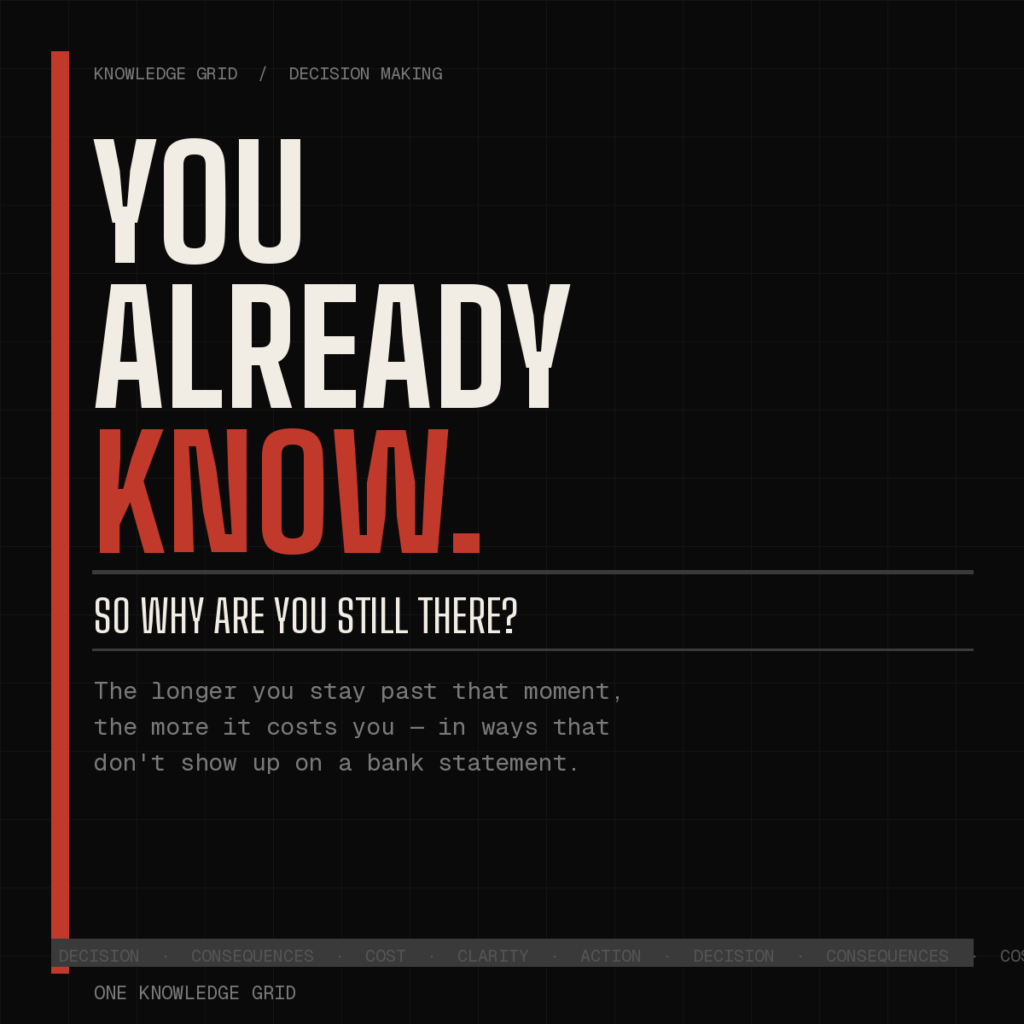
You felt it. Could’ve been six months ago. Maybe longer. That moment in a meeting, or on a Sunday night, or driving to work — where something in you went quiet and said: this isn’t it anymore.
But you’re still there. And the longer you stay past that moment, the more it costs you — in ways that don’t show up on a bank statement but are very, very real.
What Staying Past Your Time Actually Costs You
Most people only count the obvious costs. Here’s what they miss:
- Your confidence quietly erodes. Every month in the wrong place, you absorb that environment. Low-energy job? You become low-energy. Stalled business? You start feeling stalled. You don’t notice it happening. Then one day you leave and realize you’ve got a year of rebuilding to do just to feel like yourself again.
- You’re bleeding money you can’t see. If your role is $20K under market value and you stay two years, that’s $40K gone. And your next salary negotiation starts from where you are now. The gap doesn’t just sit there — it compounds forward.
- The doors you can’t see are closing. When you’re deep in the wrong situation, you stop scanning for what’s next. Opportunities pass by and you don’t even notice them because you’re too focused on managing where you already are.
Why You’re Still There (Be Honest)
It’s not because you haven’t thought about it. It’s one of these:
- Sunk cost. You’ve put in years. Leaving feels like throwing that away. But here’s the truth — what you spent is already gone. Staying longer doesn’t recover it. It just adds to the tab.
- You told people this was the move. You posted about it. You built your identity around it. Walking away means admitting it didn’t work out. Most people would rather be quietly miserable than publicly wrong.
- It’s almost working. One more quarter. One more product launch. One more review cycle. “Almost” is the most expensive place most people live. It keeps you from committing fully to staying or going — so you just drift.
Two Questions That Cut Through All of It
Skip the pros and cons list. Ask yourself these two things instead:
- If nothing changes — no lucky break, no new boss, no turnaround — where am I in 18 months? Be specific. Not hopeful. Realistic. If that picture doesn’t work for you, you already have your answer.
- When I look back at this in five years, will I regret staying this long — or leaving too soon? Most people fear the second one. But for people stuck in the wrong place, the deeper regret is almost always the first.
How to Leave Without Blowing It Up
Once you decide — and mean it — give yourself a 30 to 90 day window. Use that time to set up what comes next, not to second-guess the call you already made.
Leave with your reputation clean. Leave while you still have energy. The people who do it this way don’t just survive the transition — they hit the ground running on the other side.
The worst version is staying until you’re empty, then leaving in a mess with nothing lined up. That turns a hard decision into a hard year.
Bottom Line
The most expensive decision most people make isn’t a bad investment. It’s staying somewhere they already know is wrong — for one, two, three years longer than they needed to.
You don’t get those years back. But you do get to decide what happens next.
The question isn’t whether to go. You already know that. The question is how much longer you’re going to wait.